What to do when it all feels like too much

Too loud. Too busy. Too fast. Sometimes the world gives a child more than they can take in, and it spills over as big feelings.
It might look like crying, shouting, stamping or hiding. It might build up slowly all day and come out at home, or arrive all at once in the middle of the supermarket.
Big feelings aren’t bad behaviour. They’re a sign that something feels like too much. Here’s what can help, in the moment and on the calm days in between.
In the moment
1. Stay close and stay calm
You don’t have to fix it straight away. Being nearby, calm and unhurried is often enough. Your calm helps their body find its calm.
2. Make things quieter
Turn down the sound, dim bright lights, or move somewhere quieter if you can. Ear defenders or headphones can make a big difference when sounds are too much.
3. Use fewer words
When feelings are big, words are hard to take in and hard to find. Keep yours short and gentle.
Try pointing instead. A simple card with pictures for “I feel” and “I need” lets your child tell you what’s wrong without talking.
4. Breathe together
Slow breaths help. Breathe in, like smelling a flower. Breathe out, like blowing a bubble. Do it with your child, rather than telling them to.
5. Offer a break
A quiet corner, something soft to hold or a few minutes of space (with you nearby) can help. Let your child know they can always say, “I need a break.”
Big feelings get smaller and smaller. When I feel calm again, I am still Bold.
On a calm day
The best time to practise for a hard moment is when everything is OK.
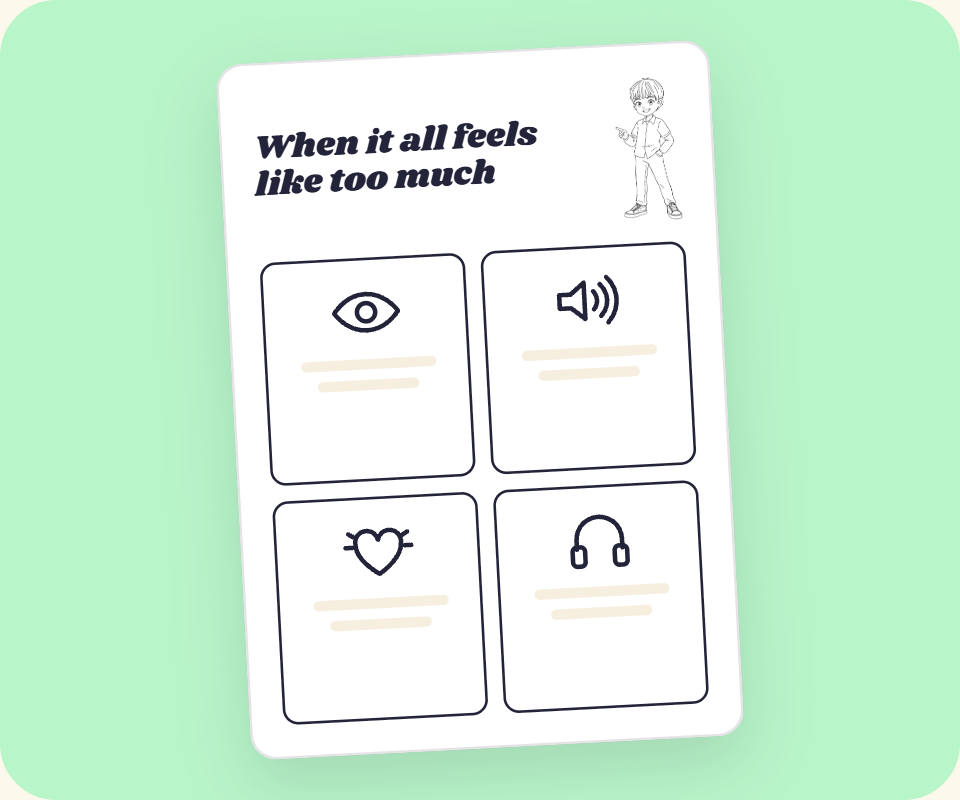
Read a social story together. Yao’s story, When it all feels like too much, shows what overwhelm can feel like and what helps. Reading it on a calm day makes it familiar for when feelings get big.
Make a calm plan. Choose together what helps: headphones, slow breaths, a quiet place, saying “I need a break” or holding something soft. Keep it somewhere easy to see.
Name feelings. It’s hard to ask for help with a feeling you don’t have a word for. Watching and naming feelings together, like happy, sad, angry and surprised, builds those words over time.
Look after you too
Helping a child through big feelings is hard work. It’s OK if you don’t always get it right. Nobody does. Making up afterwards, with a cuddle or a quiet “that was hard, wasn’t it?”, matters more than getting it perfect.
If big feelings are happening a lot, or you’re worried, talk to your GP, health visitor or your child’s school SENCo. You don’t have to work it out on your own.
Get the free Big Feelings Kit
Our free Big Feelings Kit has everything in this post, ready to print:
Yao’s story, When it all feels like too much, with a calm plan to tick and a Point to it page for when words are hard
A feelings video: Happy, Sad, Angry, Surprised
Our song, Feelings Are Our Friends
The Identifying Emotions activity, for ages 6 to 9
Your Bold Passport, with a Bold Hero certificate for when it’s full
Mornings tricky too? Read 5 ways to make mornings calmer.